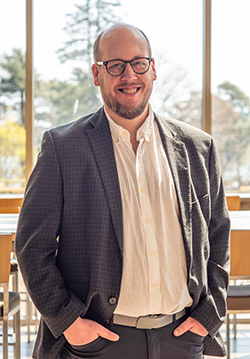
Dr. Conor Barker
Dr. Conor Barker, Ph.D., R.Psych. (NS #R00971), R.D. Psych. (SK #845)
Associate Professor, Psychology
Cross-appointed with Faculty of Education, School Psychology Programs
Office: EVR 435
Phone: (902) 457-6319
Email: conor.barker1@msvu.ca
Dr. Conor Barker is a psychologist, educator, and scholar whose work focuses on improving psychological and educational systems for people and communities that have traditionally been underserved. His scholarship brings together school and professional psychology, inclusive education, community-engaged research, and knowledge mobilization.
Before entering academia, Dr. Barker worked for more than 15 years in inclusive educational and psychological settings, including as an educational assistant, classroom and special programs teacher, and school psychologist. This practice experience continues to inform his research, teaching, student supervision, and professional contributions.
Education and Credentials
2020 — Ph.D., Educational Psychology, University of Regina
2011 — M.Ed., School and Counselling Psychology, University of Saskatchewan
2009 — B.Ed., University of Saskatchewan
2009 — B.Mus., University of Saskatchewan
2009 — Certificate in Teaching English as a Second Language, University of Saskatchewan
Registered Psychologist, Nova Scotia
Registered Doctoral Psychologist, Saskatchewan
Areas of Research
Rural, Northern, and Underserved Psychological Practice: Competency, Workforce, and Professional Standards
Dr. Barker’s primary program of research examines psychological practice in rural, northern, remote, and other underserved contexts. His work considers how psychologists develop and maintain professional competency, how geography and limited resources shape practice, and how the profession can respond creatively to workforce and access challenges.
Current research includes defining competencies for rural, northern, and remote psychological practice in Canada, examining psychometry as a strategy for increasing psychological assessment capacity, evaluating approaches to professional competency assessment, and developing research on ethics in rural psychological practice. This program builds on Dr. Barker’s doctoral research examining clinical competency among rural school psychologists.
In 2026, Dr. Barker received the Distinguished Professional Contributions to Rural and Northern Practice Award from the Rural and Northern Psychology Section of the Canadian Psychological Association.
First-Voice, Community-Engaged, and Equity-Focused Research
Dr. Barker’s second program of research centres the knowledge and experiences of people and communities who are often spoken about rather than meaningfully included in research. His work uses first-voice and community-engaged approaches to examine how educational, psychological, and social systems are experienced by the people they are intended to serve.
This research has included autistic young people’s perspectives on school inclusion; adult learners’ understandings of educational success, belonging, and previous school experiences; Black Nova Scotian perspectives on psychological and educational assessment; newcomer experiences in rural communities; inclusive education and access in French immersion and other minority-language settings; ADHD, belonging, and imposter phenomenon in higher education; and sexual and gender diversity.
Dr. Barker is Principal Investigator of a $200,000 SSHRC Partnership Development Grant examining how success is understood and experienced within rural adult basic education. Developing work also includes community-engaged autism research in St. Kitts and Nevis.
Innovation, Knowledge Mobilization, and Creative Practice in Inclusive Education
Dr. Barker’s third program of research explores how psychological knowledge, emerging technologies, and creative educational practices can contribute to more inclusive learning environments.
Current areas of study include artificial intelligence and neurodiversity, equity considerations in AI-supported teaching and assessment, neuroscience knowledge translation, inclusive French immersion, open educational resources, and creative approaches to supporting neurodivergent learners.
Across these programs, Dr. Barker is particularly interested in scholarship that moves beyond describing problems to influence professional practice, policy, education, and community decision-making.
Current Research and Scholarship
Current and developing projects include:
- Rural Psychological Practice and Ethics: Research examining professional competency, ethical practice, and the distinctive realities of psychological service delivery in rural, northern, and remote communities.
Defining Success in Adult Basic Education: A SSHRC Partnership Development Grant bringing together researchers, adult educators, learners, and community partners to develop broader understandings of educational success in rural adult basic education. - Psychological Workforce Innovation: Research examining psychometrists and other approaches to increasing access and capacity within psychological assessment services.
- Autistic First-Voice Research: Research examining autistic people’s experiences of education and developing community-engaged autism research with partners in St. Kitts and Nevis.
- ADHD, Belonging, and Higher Education: Research examining imposter phenomenon, belonging, and inclusive approaches to engaging university students with ADHD in research.
- The Inside of Coming Out: An edited collection and related research examining sexual and gender identity recognition and transformation in adulthood.
- Inclusive Education in Minority-Language Settings, including French immersion, with particular attention to access, learner diversity, specialist supports, and inclusive program design.
- Artificial Intelligence, Neurodiversity, and Inclusive Education: Research examining human-AI interaction, equity and the ethical use of AI in psychological, educational, and research contexts, AI-supported pedagogy and assessment, and the implications of emerging technologies for neurodivergent learners.
Student Supervision
Dr. Barker supervises undergraduate and graduate research across Psychology and the Faculty of Education. He has supervised undergraduate honours theses, master’s theses and projects, doctoral committee work, and postdoctoral research.
He welcomes inquiries from prospective students whose interests align with his research programs, particularly in rural and northern psychology, first-voice and community-engaged research, neurodiversity, inclusive education, psychological assessment, and emerging technologies in psychology and education.
Selected Peer-Reviewed Publications
2026
Lawy, N., & Barker, C. (2026). “Just Believe Me”: Autistic Students’ Descriptions of School Inclusion in Nova Scotia. Canadian Journal of School Psychology. https://doi.org/10.1177/08295735261472157
2025
Barker, C., & Brooks, M. (2025). Rebuilding belonging and agency in adult basic education: A choice theory/reality therapy lens. International Journal of Reality Therapy and Choice Theory, 45(1).
King, S., Ritchie, K., Leighton, L., McGonnell, M., Doe, C., Barker, C., & Yorke-Phillip, N. (2025). An examination of school psychologists’ training, competence, and needs in working with Indigenous students in Nova Scotia. Canadian Journal of School Psychology, 40(3-4). https://doi.org/10.1177/08295735251399351
Wright, A., Joy, P., & Barker, C. (2025). “Coming in” to queer psychology: The value of blending queer theory and psychology in critical autoethnography. Atlantis: Critical Studies in Gender, Culture & Social Justice, 42(2). https://doi.org/10.7202/1120019ar
2024
Barker, C., Chisholm, N., & Foran, A. (2024). Exploring mental health benefits for teachers participating in outdoor education. Journal of Adventure Education and Outdoor Learning. https://doi.org/10.1080/14729679.2024.2366927
Barker, C., Isnor, K., Mak, M., Draper, E., & Mazerolle, E. (2024). Experimental evaluation of the impact of sharing lived experiences on neuroscience knowledge translation effectiveness: Outcomes from a workshop with pre-service teachers on ADHD. Mind, Brain & Education. https://doi.org/10.1111/mbe.12408
2023
Barker, C., Madden, G., & Petersen, B. (2023). Welcome back: Exploring persistence factors for adult learners’ return to basic education in rural contexts. Canadian Journal for the Study of Adult Education, 35(2), 93–109. https://doi.org/10.56105/cjsae.v35i02.5726
2022
Barker, C., & Carlson Berg, L. (2022). Small towns talk: Clinical competency described among rural school psychologists in Saskatchewan. Canadian Journal of School Psychology, 37(4), 344-361. https://doi.org/10.1177/08295735221121059
Public Scholarship and Knowledge Mobilization
Dr. Barker regularly works to make psychological and educational research accessible beyond academic journals through public writing, media interviews, professional presentations, regulatory work, podcasts, and open educational resources.
His public scholarship has addressed rural access to mental health care, inclusive education, neurodiversity, gender and sexual diversity, educational policy, and psychological practice.
The Rural and Northern Psychologist Podcast explores research and professional issues affecting psychological practice outside Canada’s major urban centres.
Barker, C. (2023). Foundations in School Psychology. Canada Pressbooks Network. An open educational resource introducing students to the foundations, roles, and practices of school psychology, with chapters co-written by students at Mount Saint Vincent University.
His writing for The Conversation Canada has addressed rural mental health access, drag story time, gender and education policy, and other issues at the intersection of psychology, education, and public policy.