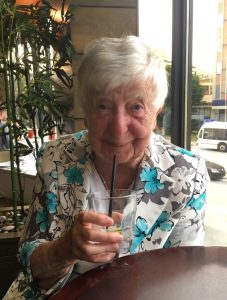
Dr. Martha Westwater
Professor Emerita
Research interests:
Victorian literature; adolescent literature
Selected publications:
Giant Despair Meets Hopeful: Kristevan Readings in Adolescent Fiction. Alberta: University of Alberta Press, 2000.
The Spasmodic Career of Sydney Dobell. Lanham and London: University Press of America, 1992.
The Wilson Sisters: A Biographical Study of Upper Middle-Class Victorian Life. Athens and London: Ohio University Press, 1984.
Obituary:
Dr. Martha Westwater died on December 9, 2025, in her native Massachusetts, where she had retired to be closer to her family. As a literary scholar and teacher, Dr. Westwater is remembered by many for her kindness and commitment to students, her passion for literature, and her belief in the importance of education.
Having joined the Sisters of Charity in 1946, Sister Agnes Martha, as she was then known, completed her B.A. and M.A. degrees at St. John’s University in New York before being assigned to various positions teaching school in New York, Quebec, and British Columbia. She published some children’s stories at this time under the pseudonym Martha Early. In1967 she was posted to St. Patrick’s High School in Halifax where she taught English to girls in grades 11 and 12. One of her former students recalls a memorable lesson when reading Lord of the Flies, how Dr. Westwater made students see and feel the horror of people’s cruelty to one another, making her young audience realize that the story was about real life, not just a book to be read in school. During her time at St. Pat’s, Martha also undertook part-time doctoral studies at Dalhousie. For young girls, the impact of seeing a woman doing her PhD in 1969 is not to be underestimated.
After successfully completing her PhD studies in Victorian literature, Dr. Westwater joined the faculty at Mount Saint Vincent as a full-time instructor in 1975, progressing through the ranks to become a full professor. Her specialties were Victorian literature and children’s literature, though she especially loved teaching first-year English, where her sense of humour and love of drama engaged many a student. Several recall how Dr. Westwater explained what a dramatic monologue was by pretending to be a student making a phone call home to parents in Cape Breton asking for more money. She also enjoyed staging a debate between herself and another teacher, each presenting opposing interpretations and leaving the students to work out how to develop their own ideas. She recalled that one of her favorite dramatic passages to teach was the defiant speech of Edmund in King Lear: “… I grow; I prosper:/ Now, gods, stand up for bastards.”
As a student advisor, she was fond of reminding anxious thesis-writers that “this is not your magnum opus, dear.” At the same time, she expected hard work – no student wanted to be interrupted mid-way through a poorly thought-out presentation with Dr. Westwater’s abrupt, “What’s your thesis?”. However, it is not difficult to find students who remember Dr. Westwater’s strong encouragement to succeed in their studies and their future careers. She especially enjoyed participating in the now legendary English Society banquets of the 70s and early 80s, which enacted different literary themes.
Her contributions to teaching were recognized in 1992 with the Mount Saint Vincent Alumnae Award for Teaching.
Dr. Westwater led an active research life, writing many articles and giving conference presentations, as well as publishing three books: two on Victorian figures: The Wilson Sisters: A Biographical Study of Upper Middle-Class Victorian Life (1984), and The Spasmodic Career of Sydney Dobell (1992). In 2000 she published Giant Despair Meets Hopeful: Kristevan Readings in Adolescent Fiction. She often told a story about her naivete as a new scholar: she had mailed out an article to a journal, but the paper was rejected and returned (this was before the existence of digital files). A colleague advised her to iron out the problems and resubmit. Taking him literally, Martha hauled out an iron and pressed out the creases in the paper before submitting it again. (It was eventually accepted). It is a long way from these innocent beginnings to the researcher who could be found in the British Museum Reading Room, or a Manhattan conference hotel, or the Paris apartment of Julia Kristeva. The latter incident is an example of what one former colleague calls Martha’s quiet chutzpah. Having been inspired by the internationally renowned theorist Julia Kristeva, Martha contacted her directly and managed to get an invitation to interview her in her home.
Dr. Westwater believed strongly in the Mount’s dedication to the education of women, and she engaged in the usual service activities expected of university professors who sustain the institution, whether it was serving on the University Senate and Board of Governors, participating in many committees, walking the picket line, or twice chairing the English Department. Once, when asked why she was wearing a cast on her arm, she replied mischievously in that native Boston accent she never lost, “I was evaluating the Dean, and my hand withered.”
Her contributions to the Mount went beyond the usual requirements. When a student explained that she could not come to class because she couldn’t afford daycare, Martha handled the problem directly by volunteering to babysit, commandeering a room, collecting some equipment, and starting a free co-op daycare for students. This endeavour evolved into the Fountain Play Centre on campus today, still mainly staffed by volunteers.
On her reluctant retirement from her full-time position in 1994 (at that time, retirement was compulsory at age 65), Dr. Westwater was awarded the rank of Professor Emerita. In 1996, she was given an honorary degree for her contributions to the Mount.
Official retirement did not end Dr. Westwater’s commitment to education. She continued to teach part-time at the Mount for six more years, and she established a literacy program for children and adults in a Dartmouth housing complex.
After surviving a devastating car accident in 1999 in which she lost two of her friends, Martha underwent a period of physical, mental, and spiritual recovery. Eventually she returned to the States and the support of her extended family, but even in this “retirement,” she continued to teach English, first at Stonehill College and then at Massasoit Community College and elsewhere. In her final years at Marillac Residence, a retirement home for religious women in Wellesley, MA, Martha taught the residents poetry, journalling, and creative writing. Here she resumed writing children’s stories, and in 2016, she wrote her last book, More than Enough, a spiritual memoir of the tremendous changes and challenges she experienced in her long life as a Sister of Charity.
Contributions in her memory can be made to the Martha E. Westwater Scholarship at Mount Saint Vincent University.
(Written by colleague Dr. Anna Smol, Professor Emerita in the Mount’s English Department.)