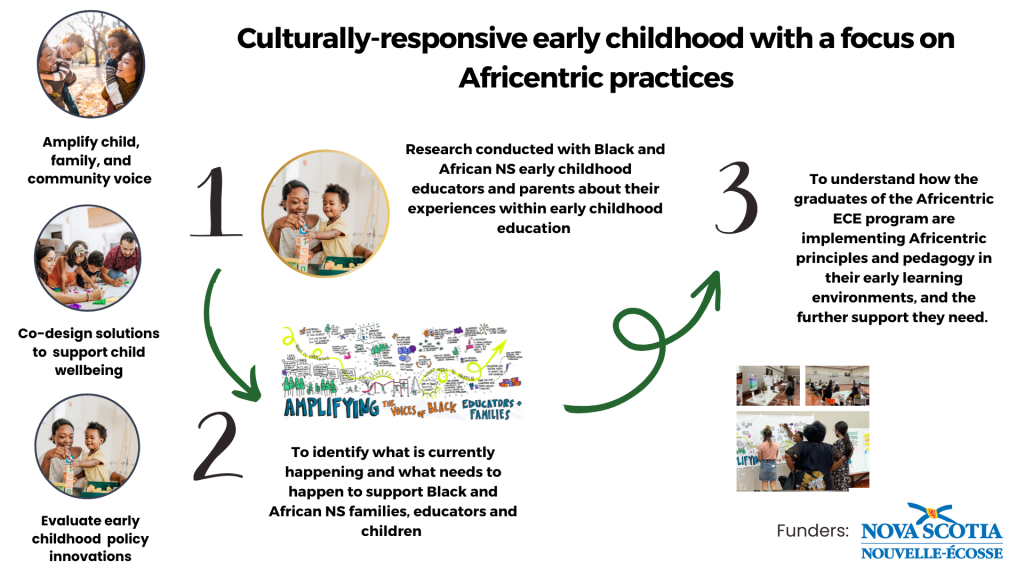
As a result of anti-Black racism, there is an opportunity gap in early childhood that can negatively impact children’s mental and physical wellbeing, academic achievement, and access to learning, recreation and play opportunities. The purpose of the study was to understand the experiences of early childhood educators (ECEs) and parents who have and care for young African Nova Scotian children in Nova Scotia through three areas:
Interviews with parents and early childhood educators who have/care for African Nova Scotian children highlighted their value for outdoor play, however the challenges they face with over-policing, stereotyping, and over-surveillance led to fear. Additionally, it was noted that outdoor play spaces were limited in many historic African Nova Scotian communities given the lack of resources and funding. A key highlight of this study also noted the prevalence of Eurocentrism in early learning curriculum, early childhood educator’s capacity to respond to racism in early learning and child care programs, and the inability to promote social justice and equity leading to culturally unsafe environments for young Black children and their families. Lastly, families and early childhood educators discussed the intergenerational impacts of racism, their experiences of racism across various systems such as the health care system and education system, and even with these systemic challenges they faced and the challenges they knew their children would go on to face given their race, parents felt that the best thing they could do to support their children was to foster self-confidence and maintain their sense of Black pride.
Early childhood educators (ECEs) play a critical role in the quality of early learning and child care (ELCC) and in setting the foundation for equity, diversity, inclusion, and accessibility. Through pedagogies, meaningful and intentional conversations, and program planning, ECEs can elicit and deepen children’s critical thinking on issues of social justice. Earlier work by our team identified that ELCC settings often adhere to mainstream norms, which promote white heteronormative values as a result of the pervasiveness of Eurocentrism, which negates the values and lived experiences of Black children, families, and educators.
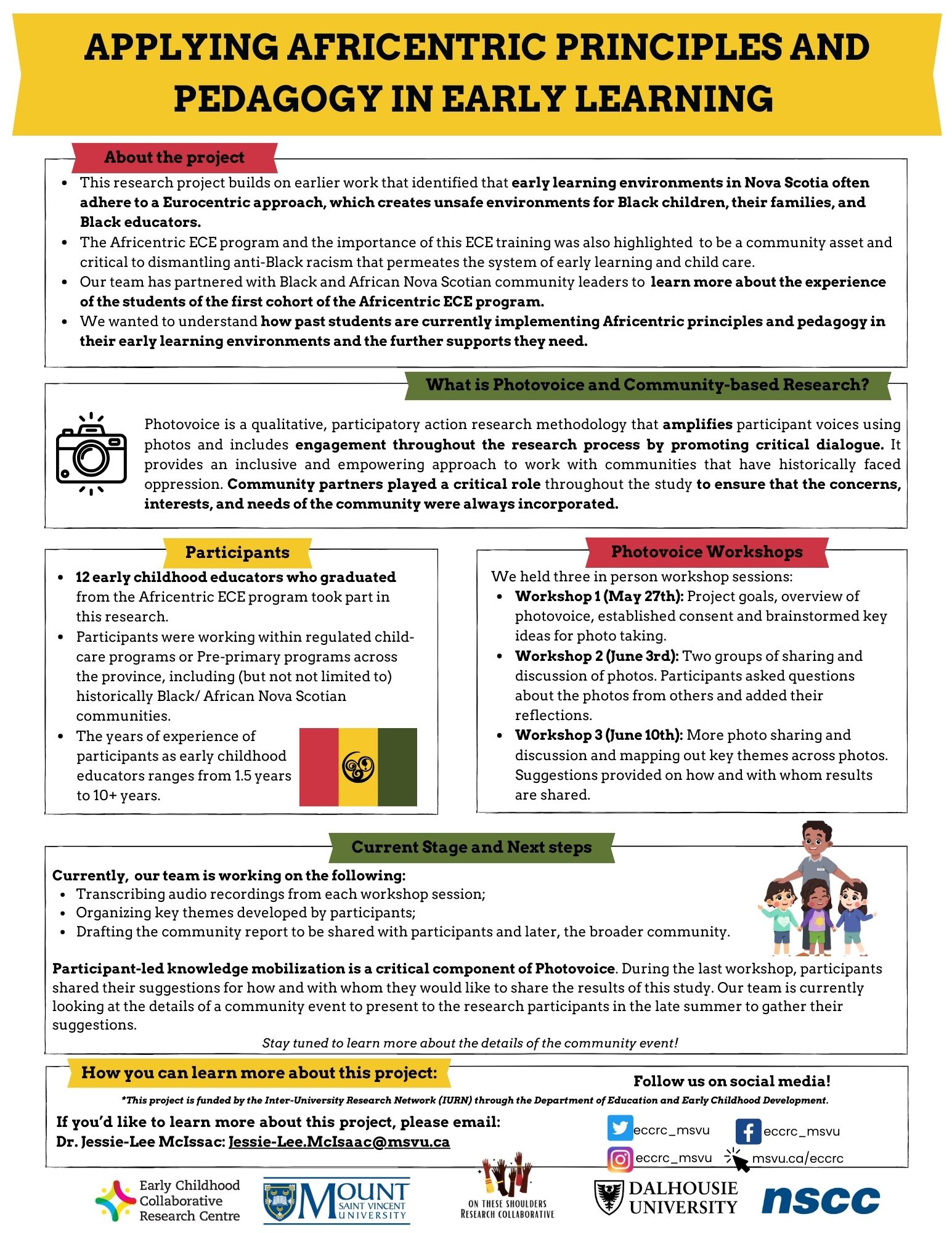
Applying Africentric Principles and Pedagogy in Early Learning: About the project
Amplifying the Voices of Black Families and Educators: A Community Event [Graphic Drawing by Rach Derrah and Vanessa]
Applying Africentric Principles and Pedagogy in Early Learning Report. McIsaac, Hamilton-Hinch, Watson, West, Shortte, Sexton, Pimentel. 2024.
Community Report – Amplifying the Voices of Black Families and Educators: Challenging Anti-Black Racism in Early Childhood Environments. Stirling-Cameron, E., Hamilton-Hinch, B., Watson, C., Hickens, N., Pimentel, M., & McIsaac, JL. 2022.
McIsaac, JLD. & Sexton, K. Applying Africentric Principles and Pedagogy in Early Learning. Virtual Professional Development. February 2025.
McIsaac, JLD., Watson, C., Pimentel, M. Outdoor & Risky Play for African Nova Scotian Children: The Impacts of Anti-Black Racism. Child Safety Link Speaker Series. November 2022.
McIsaac JLD, Hickens, N. Amplifying the Voices of Black Families and Educators: Challenging Anti-Black Racism in Early Childhood Environments. Early Childhood Collaborative Research Centre & On These Shoulders Research Collaborative. July 2022.
Department of Pediatrics and Healthy Populations Institute, Dalhousie University. (2022). One Chance to Be a Child: A data profile to inform a better future for child and youth well-being in Nova Scotia.
Read To Me. (2022). These Books are for You! An Africentric Booklist for Babies, Toddlers & Preschoolers.