CELEBRATE Feeding project will expand educator coaching across Maritimes
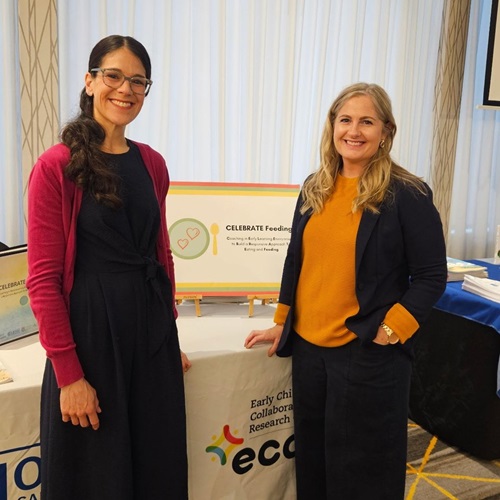 Dr. Jessie-Lee McIsaac has long-observed how a child’s environment can quietly shape their relationship with food. Now, thanks to a new Canadian Institutes of Health Research (CIHR) grant for $830,024, her team will continue their efforts to build greater understanding and awareness of what she calls “joyful eating.”
“We’re working with early childhood educators to create a supportive environment where children are encouraged to respond to their own hunger and fullness cues, while also feeling safe to explore new foods and textures,” says Jessie-Lee, Associate Professor, Tier II Canada Research Chair in Early Childhood: Diversity and Transitions, and Director of the Early Childhood Collaborative Research Centre (ECCRC) at MSVU. “We want young children to develop a positive relationship with food. It’s about building a joy and a love of eating for life.”
That joy, she said, can be missing when caregivers, often unknowingly, override children’s autonomy and control their food intake. Caregivers may not be aware that their own actions are shaped by their personal values and experiences, or broader social factors such as food insecurity or diet culture.
“We want mealtime to be about a time for connection,” she says. “Yes, it’s a chance for children to fuel their bodies, but it’s also a time to bring people together.”
The CIHR grant, awarded for 2026 to 2030, will support ‘Fostering Joyful Eaters through CELEBRATE Feeding: Coaching in Early Learning Environments to Build a Responsive Approach To Eating and Feeding.’
The initiative is the next phase of a program that Jessie-Lee and her project co-lead Misty Rossiter, a Professor and Registered Dietitian at the University of Prince Edward Island, have been building for several years. Their goal is to train early childhood educators in creating a “responsive feeding” environment – one that encourages children to explore new foods and follow their own hunger and fullness cues instead of pressuring, restricting, or rewarding them around food.
Their earlier CIHR-funded pilot placed coaches in eight childcare centres in Nova Scotia and Prince Edward Island, finding that the support changed how educators spoke and acted around meals, shifting away from pressure and toward exploration and curiosity.
The new funding will make it possible to expand CELEBRATE Feeding to significantly more child care centres across the Maritime Provinces. The research team is also incorporating an e-learning module as part of the intervention to help early childhood educators build their foundational knowledge. The team wants to explore how coaching and the self-paced module work to change practice.
Just as importantly, this next phase of study will look beyond educator practice to measure children’s own responses to food over time. The approach also asks educators to engage families and reflect a range of cultural values and practices that each child brings to the table.
“It’s that two-way communication between a child care program sharing their approach and also learning from families about what they do at home,” says Jessie-Lee.
Since the close of the first project, the research team has delivered professional development sessions to more than 1,000 educators across the region and is fielding growing interest from across Canada and well beyond. This project includes collaborators at the University of Ottawa, l’Université de Montréal, l’Université de Moncton, and the University of Nebraska.
“There’s a lot of interest from caregivers about wanting to change how we think about food with young children and being really intentional about how we’re showing up with them,” Jessie-Lee says.
More information on the CELEBRATE Feeding program is available at www.celebratefeeding.ca.