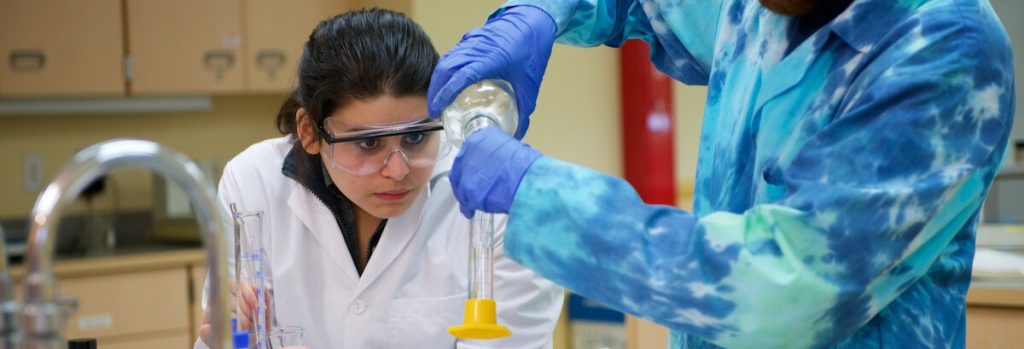
The Canadian Society for Chemistry (CSC) has recently renewed accreditation for MSVU’s Bachelor of Science Major in Chemistry program and Chemistry Joint Honours program. This achievement reflects the stand-out strength of MSVU’s Department of Chemistry and Physics, including its exceptional faculty researchers, academic programming, and student experience.
Notes the Canadian Society of Chemistry, “Accreditation ensures that educational programs have the potential to prepare graduates to practice their profession in a competent scientific manner. It also helps to maintain standards of education by providing an external audit service for programs, and by promoting the portability of the qualifications of graduates from such programs.”
The MSVU Chemistry Department is believed to be the smallest program in Canada to meet the national society’s standards for quality assurance and earn accreditation. And though they may be small, they are a truly mighty force in the field.
Students in Chemistry at MSVU choose from a variety of degree programs and concentration options. Thanks to early access to research opportunities less common at larger universities, a number of MSVU Chemistry students have co-published in peer-reviewed journals and presented at chemistry conferences during their undergraduate studies. Many have continued into prestigious graduate programs, including medical school, optometry programs, graduate studies in Chemistry, and much more. In his final year of studies at MSVU, then BSc Chemistry (Honours) student Jake Yorke was named MSVU’s first Rhodes Scholar – an extraordinary recognition that includes a scholarship to study at Oxford University in the UK.
A big part of what sets the MSVU Chemistry Department apart is its amazing faculty. In fact, many of the department’s faculty are recent award winners (including research grant holders) and working on world-leading research.
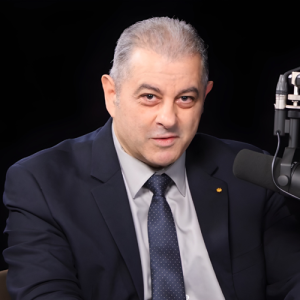 Take Professor Dr. Chérif Matta, for example. On November 20, he received one of the local science community’s most prestigious awards: the Professional of Distinction Award presented as part of the Discovery Awards. The award recognizes “a science and/or technology researcher or developer who demonstrates ingenuity and innovative thinking in the creation of unique ideas, concepts, perspectives, processes, etc. within their field.” Chérif also received an Alumni Award of Distinction from his alma mater, McMaster University, the same day.
Chérif’s world-leading work has both a biological application and drug design bent, and spans the continuum between physical chemistry and chemical physics. Chérif developed the concept of the electron localization-delocalization matrices (LDMs) and uses it as a tool to understand chemical properties and reactivity.
Meet the other fantastic full-time faculty and lab instructors in Chemistry at MSVU:
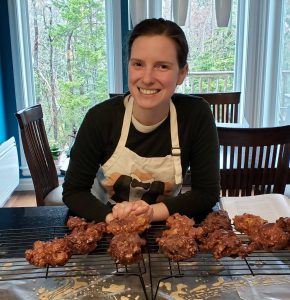
Alyssa frequently teaches labs in organic chemistry, inorganic chemistry, biochemistry, and metabolism. Her goals in lab instruction are to teach students the relevant hands-on and problem-solving skills they need to be successful in their chosen fields. She is interested in ensuring labs relate to real-world scenarios (baking is one of her favourite chemistry topics!) and that students gain experience using specialized instrumentation. Her primary goal is that students enjoy experimentation in the lab and leave feeling confident in their skills and knowledge.
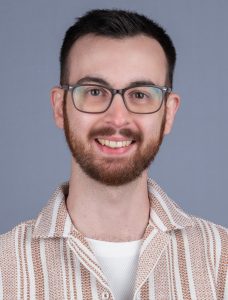 Dr. Michael Land, Assistant Professor
Michael is a brand-new professor at MSVU with a background in inorganic chemistry. His research lab focuses on the design and synthesis of new ligand scaffolds that promote unique reactivity and unconventional bonding motifs in both transition metal and main-group compounds. These compounds can be used to develop materials with new properties for nanoelectronics, conductive materials, or for the extraction, separation, and rapid identification of Canada’s critical mineral resources. The foundation for these research themes stems from the courses Michael teaches which include several Inorganic Chemistry courses and Organic Structure Determination.
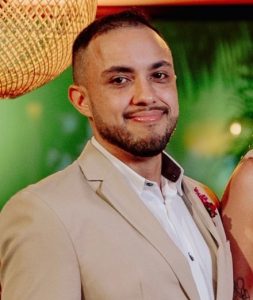 Dr. Dhésmon Lima, Assistant Professor
Dhésmon currently serves as the MSVU Chemistry representative with Science Atlantic, and his research specializes in designing and developing electrochemical sensors utilizing inorganic nanomaterials for the detection of environmental contaminants and disease biomarkers while also investigating biomolecular interactions through electroanalytical methods. His research group actively involves undergraduate students, providing hands-on experience in electrochemistry, nanomaterials, sensor development, and analytical method validation. His teaching mostly focuses on introductory Chemistry courses, as well as Analytical and Environmental Chemistry, using online tools and active learning techniques.
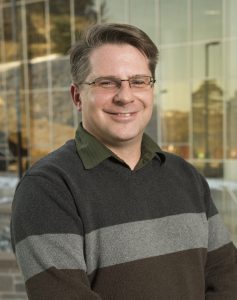 Dr. Ian Pottie, Department Chair and Professor
Ian’s research stands to transform Alzheimer’s disease diagnosis. His work focuses on a new diagnostic agent that targets butyrylcholinesterase allowing for non-invasive and early diagnosis of Alzheimer’s disease in living patients. Ian’s research interests also include natural product synthesis, asymmetric synthesis, Henry reaction, Diels-Alder reaction, and multiple sclerosis.
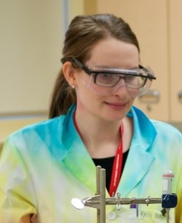 Dr. Kelly Resmer, Lab Instructor
Kelly frequently teaches labs in general chemistry, biochemistry, metabolism, and analytical chemistry. She emphasizes the use of technology, inquiry-based labs, and new assessment techniques to effectively teach undergraduate students.
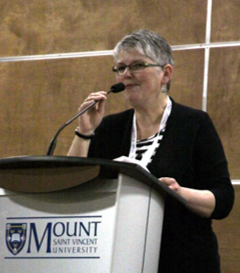 Dr. Katherine Darvesh, Professor Emerita
Professor Emerita Dr. Kathy Darvesh has been recognized as one of Canada’s top chemistry educators at the post-secondary level by College Chemistry Canada. Kathy has led efforts to organize student conferences and events for colleagues that focus on teaching. Her research areas of focus include quantum chemistry, structure-activity relationships, and chemical education.