The Electroencephalography (EEG) Lab at Mount Saint Vincent University is reshaping how neuroscience research is conducted and advancing research into how the brain responds to stress.
Led by Dr. Christine Lackner, the lab examines how childhood experiences shape later brain development, cognitive function, and mental health. In recent years, the lab has taken on a new, transformative direction: understanding how racial stress and trauma affect brain activity and ensuring that people from marginalized communities are not left out of scientific research. It’s work that has not only shifted the lab’s research priorities, but has also challenged long‑standing practices in neuroscience and pioneered new, more inclusive methods of collecting EEG data.
An Evolving Research Program
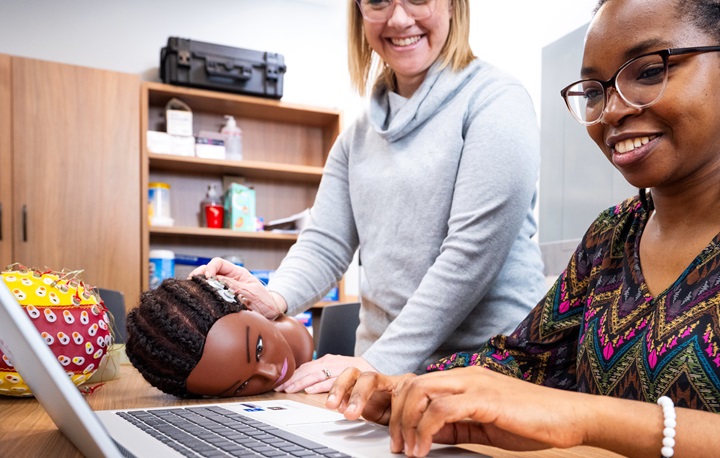
Much of Dr. Lackner’s research examines developmental neuroscience, exploring how both positive and adverse childhood experiences affect later-life physical health, cognition, and mental well‑being. Dr. Lackner previously studied how parenting styles and behaviours impact development for children, for example through factors like early cigarette smoke exposure. In 2020, Noémie Bergeron-Germain, an honours student at the time, approached her with a simple yet powerful question: Had she ever considered how racial stress and trauma influence brain activity? That question opened an entirely new avenue of research. “This project has been incredibly transformative for my work,” Dr. Lackner explains. “It came from a student who was courageous enough to ask a question that hadn’t been asked in our lab before. Saying ‘hey, have you ever thought about these kinds of stressors or traumas?’ And I said no, I haven’t investigated that, but let’s see what we can do.”
The racial stress study is divided into two phases. In phase one, participants complete a detailed questionnaire about their lived experiences as members of marginalized communities, including community context, reactions to racialized experiences, and mental health. The goal is to acknowledge that adverse experiences are not “one-size-fits-all”; two people may encounter similar events but interpret them very differently, and those subjective experiences matter deeply in understanding brain development. In phase two, participants visit the EEG lab where researchers collect brainwave data to examine how racial stress may be linked to neurological processing.
This field of research revealed a major challenge: traditional EEG equipment was not designed for participants with thick, coily or curly hair. Thick or tightly coiled hair prevents the electrodes from making full contact with the scalp, leading to poor‑quality signals. The result? Participants—especially Black participants—were routinely excluded from EEG research because their data was unusable. “We now know that this has been happening systematically,” Dr. Lackner says. “And once we saw it clearly [in the data], we couldn’t go back.”
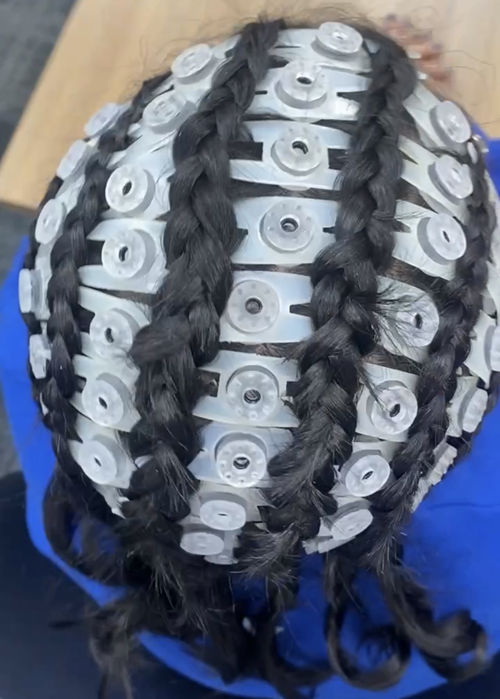 A turning point came when Noémie learned about a new tool: the SEVO clip. Designed by Arnelle Etienne, with Precision Neuroscopics, the SEVO clip is designed specifically to improve EEG data collection for people with coily or curly hair. These small 3D‑printed “butterfly clips” fit between cornrowed sections of hair, allowing electrodes to sit securely against the scalp without requiring an EEG cap. Their simplicity and effectiveness makes them game‑changers.
Ana Julia Gomes Nobre, a current graduate research assistant for the EEG Lab, completed her undergraduate thesis comparing the data quality from SEVO clips to traditional EEG caps. The results were clear: SEVO clips produce reliable, high‑quality EEG signals, opening the door to fully inclusive research. “We were able to collect a good and reliable signal with the SEVO clips,” Ana explains. “It was the first major step taken to ensure participants with coiled and curly hair weren’t excluded.”
The EEG Lab is currently the only lab in Canada using SEVO clips — making the work both urgent and uniquely positioned. “There is a historical trend that we have seen in neuroscience, where there is no effort in the inclusion of diverse participants. If we don’t have a sample that represents everyone, then the results of your study are not representative of your population. You need to have diverse in diversity in your sample that represents your population so that you can make results that are generalizable for everyone.” Ana added.
Rebuilding Trust Through Representation and Outreach
The racial stress study is about more than new tools; it’s about repairing a long history of exclusion in research. Ana, who has led much of the community outreach, explains that mistrust of scientific research is entirely justified among many Black communities due to historical exploitation and unethical studies. “To change the narrative,” she says, “we have to show that the lab represents the communities it serves.” The lab’s recruitment team is made up of diverse students from Latin American, African Nova-Scotian, and Indigenous backgrounds, and attends various academic and local events within the community to talk about neuroscience with historically underrepresented communities and recruit participants.
One of the lab’s most innovative contributions is a comprehensive EEG lab manual created by Ana. It guides researchers on understanding hair types and culturally specific hairstyles; knowing when to use SEVO clips vs. EEG caps; ensuring flexibility around wash days and hair care routines; building trust with participants who may feel vulnerable or hesitant; and best practices for inclusive recruitment and community presence. A formal protocol manuscript is in development, so these inclusive practices can be shared with EEG researchers worldwide.
The EEG lab’s practices demonstrate the impact that listening to marginalized communities, including people whose experiences have historically been excluded from scientific study, can have on advancing neurological research. A simple question sparked a shift in research, and a small clip opened the door to greater inclusivity in neuroscience research.
Racial Stress Study Still Seeking Participants
The racial stress study is ongoing, and researchers are currently seeking participants from minority communities whose hair type is appropriate for the SEVO clip method. Interested individuals who would like to participate can email brainwaves@msvu.ca for more information. The EEG Lab will reimburse participants for cornrow installation (with a receipt) and travel costs (up to $70). Participants get a $10 Amazon card for completing part 1 and $40 cash for part 2.